Custom Software vs Off-the-Shelf: Which Should You Choose?
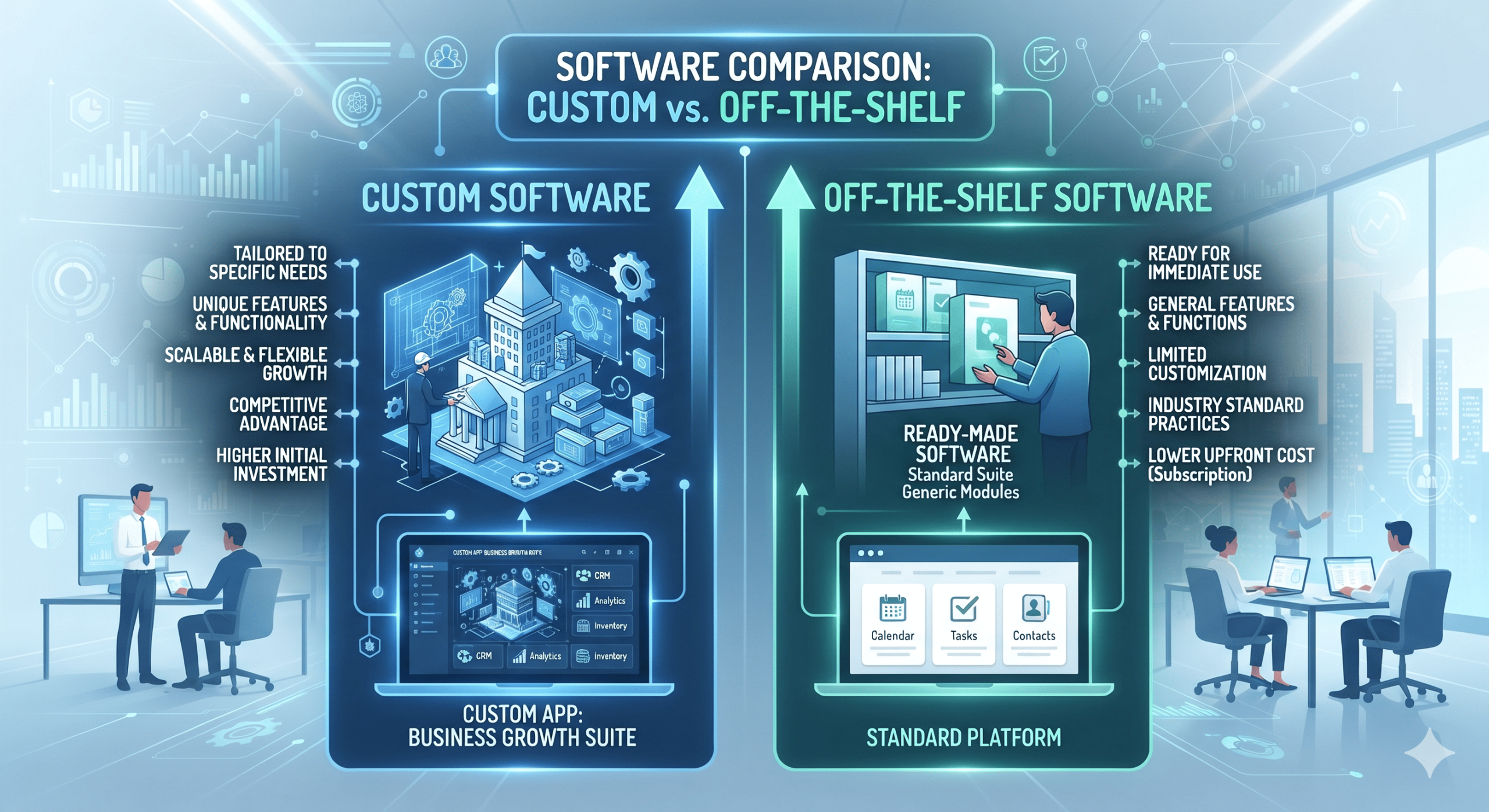
Choosing the right software can influence how efficiently your business operates, manages data, serves customers, and scales over time. While some businesses benefit from ready-made applications, others need solutions designed around their specific workflows and long-term goals. Understanding the difference between custom software and off-the-shelf products can help you make an informed investment.
When comparing custom software vs off the shelf solutions, the decision comes down to your business requirements, budget, implementation timeline, and future plans. Both approaches offer distinct advantages, but the right choice depends on how well the software supports your operations.
What Is Custom Software?
Custom software is an application developed specifically for a business’s requirements. Instead of adapting your operations to a predefined system, you invest in software designed around your workflows, users, and objectives.
For example, a logistics company may need a platform that combines shipment tracking, route planning, inventory management, and customer notifications. A custom solution can bring these functions together in one integrated system.
Custom software development typically involves requirement analysis, UI/UX design, development, testing, deployment, and ongoing maintenance. The features and technology stack can be selected according to your business needs.
Key Benefits of Custom Software
- Tailored functionality: Includes features relevant to your business processes.
- Greater flexibility: Allows changes as requirements and operations evolve.
- Integration capabilities: Can connect with existing CRM, ERP, accounting, and other business systems.
- Scalability: Can be expanded as your customer base, workforce, or operational complexity grows.
- Greater control: Gives your business more influence over the product roadmap and development priorities.
However, custom software generally requires a higher initial investment, a longer development timeline, and a clear maintenance strategy.
What Is Off-the-Shelf Software?
Off-the-shelf software is a ready-made application developed for a broad market or a specific category of users. Businesses can purchase a license or subscription and configure the available features to suit their requirements.
Examples include accounting applications, project management tools, customer relationship management platforms, and ready-made HR software.
These products are often designed around common business processes, making them suitable for organizations that do not need extensive customization.
Key Benefits of Off-the-Shelf Software
- Faster implementation: Many solutions are ready to use with minimal setup.
- Lower initial costs: Subscription plans can reduce upfront investment.
- Established functionality: Businesses can use features that have already been developed and tested.
- Vendor support: Providers may offer technical assistance, documentation, training, and regular updates.
- Predictable features: Pricing tiers and feature lists make initial comparisons easier.
The main limitation is that ready-made software may not support every business requirement. Customization options can be restricted by the vendor, subscription plan, or underlying system architecture.
Custom Software vs Off-the-Shelf: Key Differences
Understanding the practical differences between these approaches makes it easier to evaluate which option fits your business.
| Comparison Factor | Custom Software | Off-the-Shelf Software |
| Development | Built around specific business requirements | Developed for a broader user base |
| Initial cost | Generally higher | Usually lower |
| Implementation | Requires development and testing | Often faster to deploy |
| Customization | Greater control over functionality | Limited to available configuration and extensions |
| Scalability | Can be designed around future requirements | Depends on product capabilities and pricing plans |
| Integration | Can be developed for specific systems and workflows | Depends on available integrations and APIs |
| Maintenance | Requires a dedicated internal team or development partner | Usually supported by the vendor, depending on the plan |
| Ownership and control | Depends on the contract and intellectual property terms | Generally controlled by the software vendor |
| Best suited for | Unique workflows and specialized requirements | Standard business processes and common needs |
Neither option is automatically better. Your decision should reflect your current operations, expected growth, available resources, and the level of control you need.
Bespoke Software vs Off-the-Shelf: What Is the Difference?
The terms custom software and bespoke software are often used interchangeably. Both refer to software developed to meet specific business requirements rather than a broad set of standard market needs.
Therefore, when comparing bespoke software vs off the shelf solutions, the fundamental difference remains the same: bespoke software is built around your business, while off-the-shelf software is designed for a wider audience.
For example, a company with standard sales and customer management requirements might find an existing CRM platform sufficient. However, an organization with complex approval processes, industry-specific reporting, and multiple interconnected systems may benefit from a bespoke CRM solution.
Bespoke development can provide greater control over workflows, integrations, and feature priorities. However, businesses must also consider development costs, maintenance responsibilities, security requirements, and the time needed to deliver the solution.
When Should You Choose Custom Software?
Custom software may be the right choice when standard applications cannot adequately support your operations or strategic objectives.
Consider custom development if:
- Your workflows are specialized: Your business follows processes that standard applications cannot accommodate without significant workarounds.
- You need multiple integrations: Your operations depend on data moving between several existing systems.
- Your business is scaling: You expect substantial changes in users, transaction volumes, locations, or operational complexity.
- You need specialized functionality: Your business requires industry-specific features, reporting, automation, or customer experiences.
- You want greater product control: You need the ability to prioritize features and manage development according to business objectives.
For example, a growing enterprise may need a centralized platform connecting HR, finance, inventory, and operations. A custom solution can be designed around these requirements instead of relying on disconnected applications.
Before investing, assess the total cost of development and maintenance, define your essential features, and establish measurable business objectives.
When Is Off-the-Shelf Software the Better Option?
Off-the-shelf software can be a practical choice when your requirements align with established industry practices and you need a solution quickly.
It may be more suitable if:
- Your requirements are standard: Your business needs common functions such as invoicing, scheduling, or basic project management.
- You have a limited initial budget: Subscription-based software may be more accessible than funding a complete development project.
- You need rapid deployment: Your team needs to start using the system without waiting for a custom development cycle.
- You want vendor-managed updates: The provider handles product improvements and routine platform maintenance within the scope of its service.
- Your customization needs are limited: Available settings and integrations cover most of your requirements.
However, review subscription costs, user limits, data portability, integration restrictions, and vendor dependency before making a long-term commitment.
Custom Software vs Off-the-Shelf: What About the Total Cost?
Initial pricing is only one part of the decision. A more accurate comparison considers the total cost of ownership over the expected life of the software.
Custom software may involve requirements analysis, design, development, testing, hosting, security updates, and ongoing enhancements. Although the initial investment can be substantial, the solution may reduce manual work or the need for multiple disconnected tools.
Off-the-shelf software may require lower upfront spending, but recurring subscriptions, premium features, additional users, integration services, and future price increases can affect the overall cost.
Evaluate both options using a realistic three-to-five-year cost estimate. Include implementation, training, support, maintenance, and potential productivity gains. This approach helps you compare the financial implications rather than choosing solely on the initial price.
Can You Combine Custom and Off-the-Shelf Software?
Yes. A hybrid approach can offer a practical balance between speed, cost, and flexibility.
Your business could use an established accounting platform, a ready-made CRM, and custom software to connect these systems or support a specialized operational process.
For instance, an e-commerce company might use an existing payment gateway and accounting application while investing in a custom order management system. This approach avoids rebuilding standard functionality while addressing specific business requirements.
The key is to identify which processes genuinely require customization and which can be handled effectively by existing products. Integration quality, data consistency, security, and long-term maintenance should all be considered when designing a hybrid software environment.
How to Choose the Right Software for Your Business?
Before making a decision, evaluate the following factors:
- Define your requirements: Identify essential features, current operational challenges, and the outcomes you expect.
- Assess your existing systems: Determine whether available products integrate with your current technology stack.
- Set a realistic budget: Include implementation, licensing, maintenance, training, and future enhancements.
- Consider future growth: Evaluate whether the solution can accommodate new users, business units, and changing workflows.
- Compare available options: Test relevant off-the-shelf products before deciding that custom development is necessary.
- Calculate long-term value: Consider productivity, process efficiency, flexibility, and the cost of changing platforms later.
The objective is not to select the most feature-rich or expensive solution. It is to choose software that solves your business problems effectively and supports your plans for growth.
Conclusion
The choice between custom software and off-the-shelf products depends on how closely existing solutions match your business requirements. Off-the-shelf software can be ideal for standard processes, faster implementation, and lower initial costs. Custom software is worth considering when specialized workflows, complex integrations, and greater control are important.
At WEBaniX Solutions, we help businesses evaluate their technology requirements and develop software solutions aligned with their operational goals. From custom application development and system integration to scalable enterprise solutions, our approach focuses on addressing practical business challenges.
Looking for the right software solution for your business? Connect with WEBaniX Solutions to discuss your requirements and explore whether custom development, off-the-shelf software, or a hybrid approach best fits your needs.