What If You Could Change the Possibility of Alien Life With Just a Wave of Your Hand?
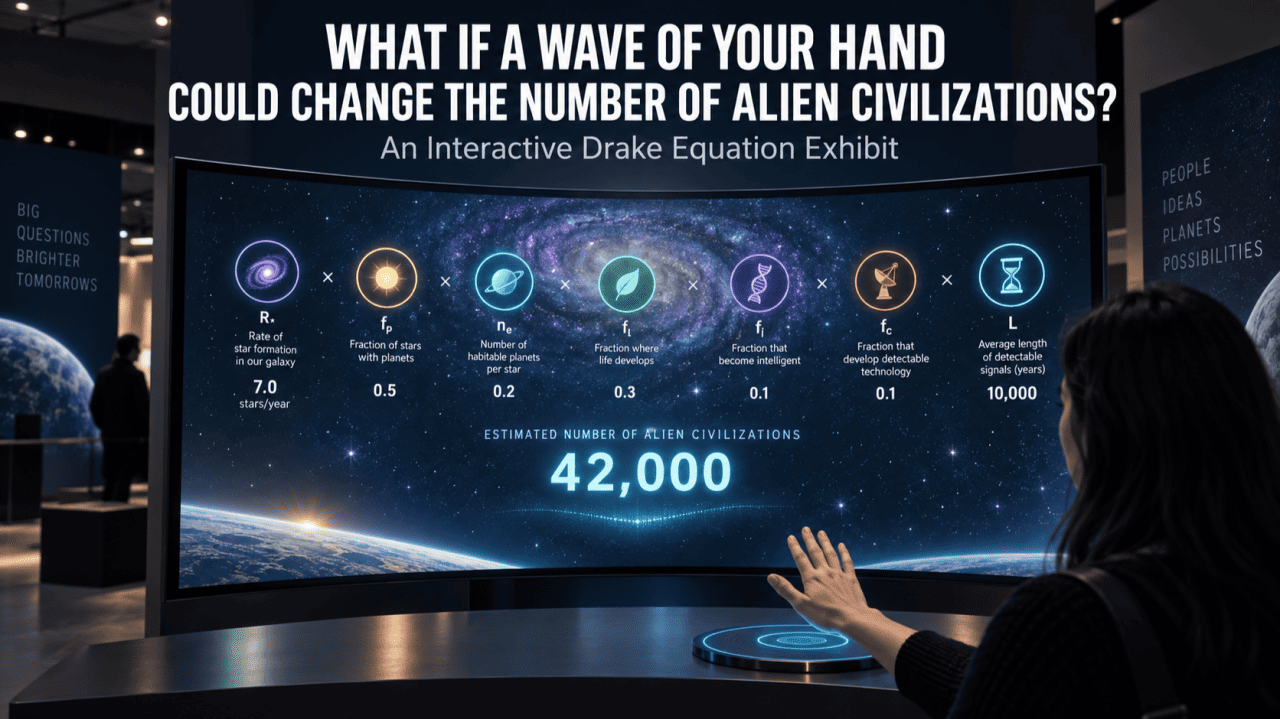
That was the idea behind an interactive science exhibit we built around one of astronomy’s most intriguing questions: Are we alone in the universe?
The exhibit was based on the Drake Equation, a scientific formula used to estimate the possible number of communicating civilizations in the Milky Way.
But there was a problem.
An equation can be fascinating to a scientist and completely intimidating to someone seeing it for the first time.
So instead of asking visitors to stand in front of a screen and read about seven variables, we turned the equation into an experience. Visitors could make their own choices, interact with the system, and see how those choices changed the final result.
For us, this was a great example of how Interactive Technology can make complex ideas easier to understand and more engaging to experience.
Turning the Drake Equation Into Something People Could Interact With
The mathematics behind the Drake Equation wasn’t the difficult part.
The real challenge was designing an experience that could explain seven different variables without overwhelming the visitor.
Each variable represented a different factor involved in estimating the number of potentially communicating civilizations. Rather than presenting these as a traditional questionnaire, we wanted visitors to actively participate in the process.
The experience needed to be:
- Simple enough for first-time visitors to understand
- Interactive without relying on a keyboard or mouse
- Available in both English and Hindi
- Reliable enough to operate continuously in a public environment
That meant the project wasn’t just about displaying information. It involved game development, hardware integration, interaction design, visual feedback, and system optimization.
Replacing the Touchscreen With a Wave of the Hand
One of the most interesting parts of the project was deciding how visitors would interact with the variables.
A conventional touchscreen slider would have worked, but we wanted something that felt more natural and immersive.
So we connected a time-of-flight distance sensor to an Arduino.
The interaction was simple.
Move your hand closer, and the value would change in one direction. Move it farther away, and it would change in the other.
What appeared to visitors as a simple hand movement required considerably more engineering behind the scenes.
The sensor had to communicate reliably with the application. We added calibration and smoothing logic to prevent small or unintended movements from causing sudden changes in the value.
The interaction therefore became a combination of hardware input, communication, software logic, calibration, and visual feedback.
That is where Interactive Technology becomes particularly interesting. The technology disappears into the experience, allowing the user to focus on what they are doing rather than how the system works.
Building an Exhibit That Could Run on Its Own
A public exhibit has a different set of requirements from a typical software application.
You can’t assume that someone will be standing beside it all day to restart the system if something goes wrong.
The application needed to be reliable during continuous operation.
During testing, extended use could cause performance issues, including lag and occasional crashes. We therefore focused on optimization as much as functionality.
Graphics were optimized for lower-resolution environments, while assets were preloaded to reduce delays during interaction.
We also introduced timers so the experience could move forward if someone walked away midway through the process. Errors were logged quietly instead of interrupting the visitor with unnecessary system messages.
These details may not be visible to the person using the exhibit, but they are essential to creating a smooth interactive experience.
Where Game Development Meets Education
Although the project was built around a scientific concept, several principles from Game Development shaped the experience.
There was a clear interaction loop:
Choose → Interact → See the Result → Continue → Discover
Visitors weren’t simply consuming information. They were making decisions and immediately seeing how those decisions affected the outcome.
After going through all seven variables, the system calculated the estimated value of N in the Drake Equation—the potential number of communicating civilizations based on the visitor’s selections.
And that created an interesting moment.
Two visitors could make different choices and arrive at completely different results.
The science remained the same, but the experience became personal.
This is one of the areas where Game Development Services can extend beyond traditional games. The same thinking used to create engaging gameplay can be applied to educational applications, interactive exhibits, simulations, training experiences, and other digital experiences where user participation matters.
Making Complex Technology Feel Simple
From the outside, the exhibit looked straightforward.
A visitor moved a hand, selected a value, and watched the equation change.
Behind that interaction were multiple technologies working together: Arduino hardware, distance sensing, application logic, calibration, graphics optimization, asset management, and interaction design.
That contrast was one of the most rewarding parts of the project.
The engineering was complex, but the experience didn’t need to feel complex.
For us at WebaniX, that’s an important principle when developing interactive solutions. Technology should support the experience rather than become the experience.
Whether we’re working on game development, educational applications, AR experiences, or custom interactive solutions, the goal is to make the technology purposeful and intuitive.
What This Project Taught Us
Building the Drake Equation exhibit reinforced something we see across interactive projects: engagement often comes from participation.
A visitor might forget a paragraph they read on a display. But they are more likely to remember an experience where their own actions changed what they saw.
That is the potential of combining Game Development Services with Interactive Technology.
A scientific equation became a hands-on experience. A complex concept became something visitors could explore. And a question about life elsewhere in the galaxy became something each person could answer differently.
Sometimes, the most effective way to explain a complicated idea isn’t to simplify the idea itself.
It’s to give people a way to experience it.
Build an Interactive Experience With WebaniX
Have an idea that could be more engaging as an interactive application, educational experience, simulation, or game?
Our Game Development Services combine software development, interaction design, and technologies such as Unity, AR, APIs, and hardware integration to turn concepts into engaging digital experiences.Get in touch with us today and bring your interactive idea to life.