Case Study
Industrial Heater Sizing and Quotation Through an Integrated Engineering & Automation Platform
Industry
Manufacturing
Platform
Integrated Workflow System, Node JS, React JS
Behind the Scenes
Custom Software, System Integration, Workflow Automation
Client Overview


Challenges
- Incoming customer RFQs needed to be reviewed, assigned, and converted into engineering work without unnecessary manual handling.
- Complex PDF and Word datasheets contained numerous technical parameters that needed to be transferred accurately into engineering workflows.
- Customer, project, and SAP enquiry information needed to remain consistent across the sizing and quotation process.
- Process heater sizing involved multiple thermodynamic, mechanical, metallurgy, and electrical parameters that needed to be evaluated systematically.
- Engineering calculations required a structured multi-step workflow covering heater configuration, technical parameters, element sizing, flange and vessel sizing, and final validation.
- Component heaters and control panels required dedicated calculation and engineering workflows within the same platform.
- BOM costing required component pricing, raw material pricing, additional costs, and sales margins to be brought together.
- Commercial offers needed to be generated from completed engineering calculations rather than prepared through disconnected processes.
- SAP ERP quotation booking needed to be connected with the engineering and commercial workflow.
- Project documents needed to be organized using a standardized structure and synchronized with SharePoint.
- Different engineering, estimation, sales, and administrative users required access based on their roles and privileges.
- Master data such as process fluids, sheath materials, flange weights, pipe schedules, pricing, and configuration parameters needed to be centrally maintained.
Root Cause
- The primary challenge was the lack of a unified workflow connecting enquiry intake, engineering calculations, costing, quotation generation, ERP integration, and project documentation.
- RFQ specifications, customer information, engineering parameters, calculation results, BOM data, commercial offers, and project documents formed part of the same operational lifecycle but required coordinated handling across different activities.
- Manual transfer of technical information from complex RFQ documents into sizing forms could introduce additional effort and create opportunities for transcription errors. The Marathon documentation specifically identifies this as a challenge addressed by the AI Enquiry Parser.
- Without a connected engineering and commercial workflow, teams could face difficulties maintaining consistency between technical calculations, costing, quotations, ERP records, and supporting documentation.
- A centralized engineering platform was therefore required to establish a connected source of information across the complete heater sizing and quotation lifecycle.
Solutions
- A centralized Marathon Heater Sizing & Quotation Platform was developed to connect enquiry management, AI-assisted specification extraction, customer projects, engineering calculations, costing, quotation generation, SAP ERP integration, SharePoint storage, and administration within one system.
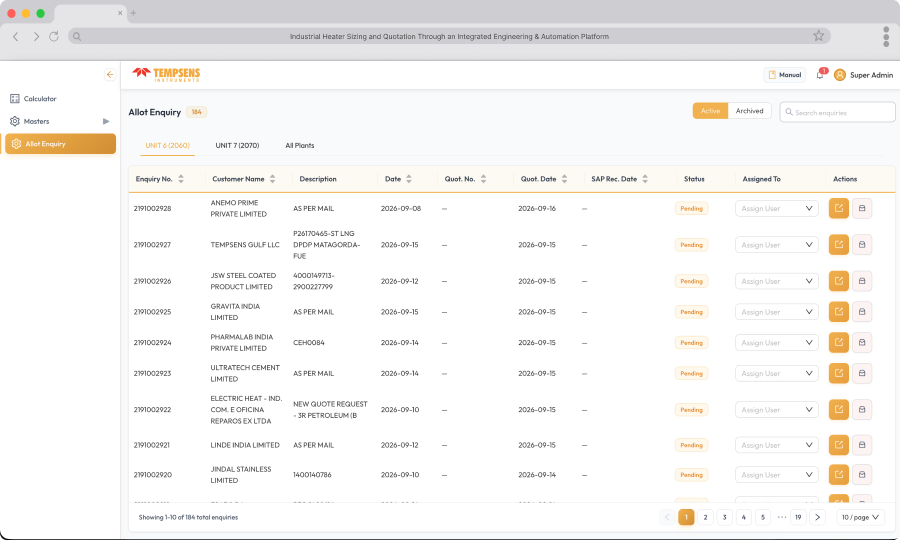
- The platform introduced a structured enquiry work queue for managing incoming RFQs. Inquiries can be filtered by manufacturing plant, assigned to design engineers, picked up for processing, and moved through defined workflow statuses from pending and assigned to in-progress and completed.
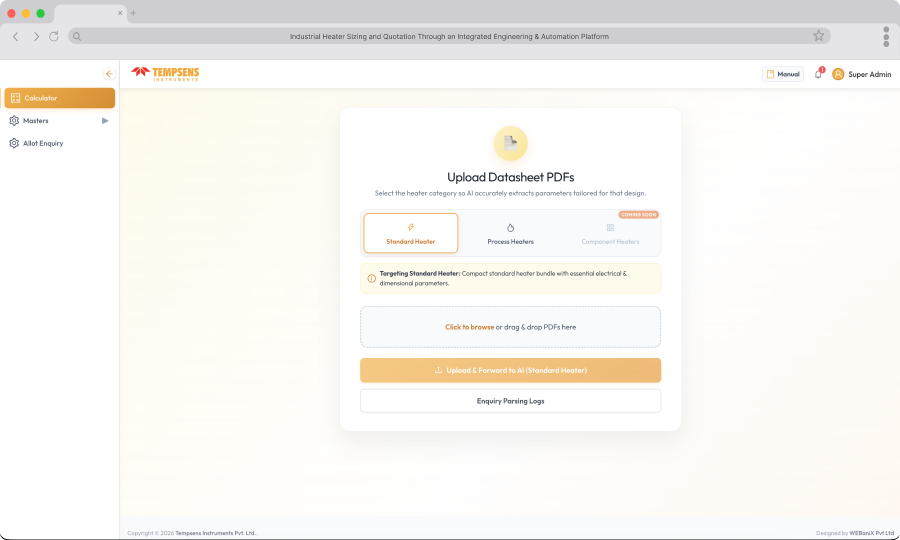
- An AI Enquiry Parser was implemented to process PDF and DOCX specification documents and extract up to 80 engineering parameters using natural language processing and computer vision. The extracted information covers client and project metadata, process conditions, thermodynamic properties, mechanical and metallurgy information, and electrical and hazardous-area parameters.
- A verification workbench allows engineers to review extracted information before using it in the engineering workflow. Parameters are organized into engineering categories, confidence indicators identify fields requiring review, and engineers can correct values directly before creating the customer project and calculation.
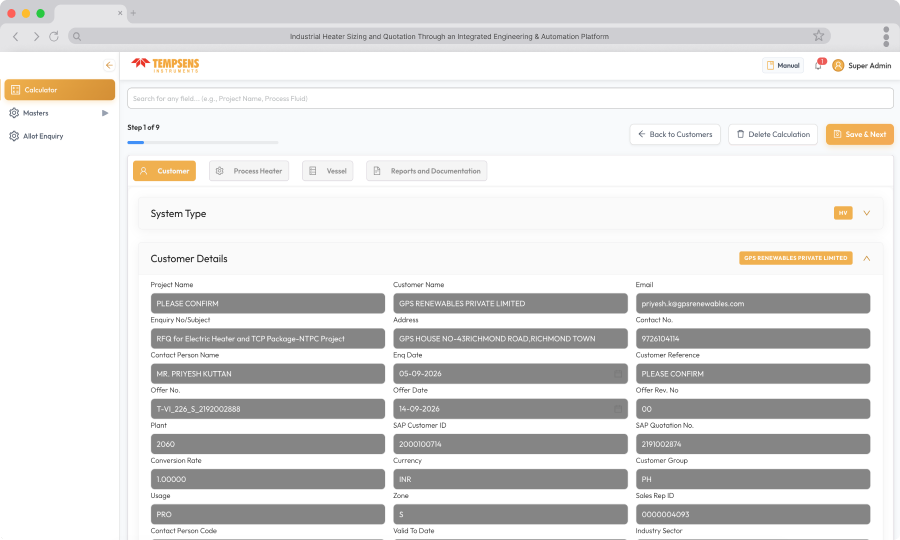
- SAP ERP integration was incorporated into the customer management workflow. By entering an SAP enquiry number, the platform can retrieve customer information, plant allocation, billing and shipping details, currency, sales representative, project due date, and contact information through SAP ERP RFC integration.
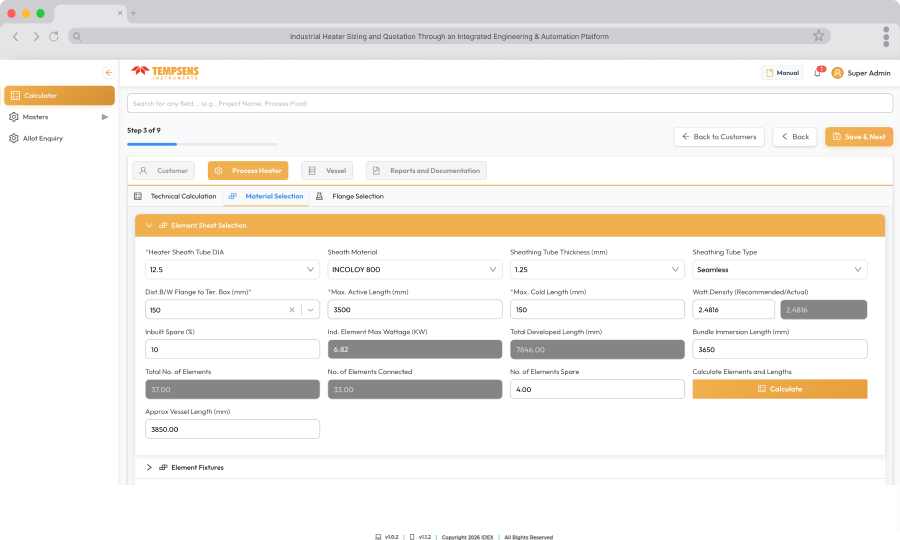
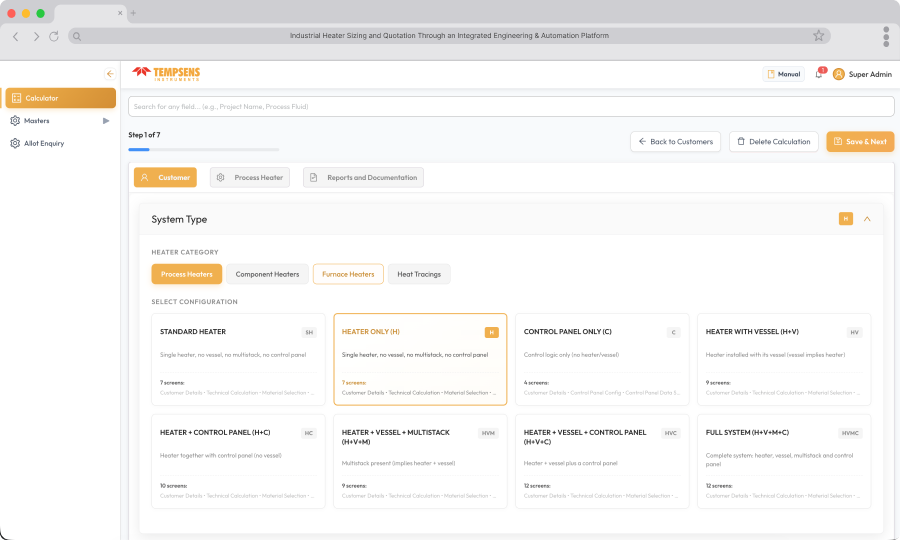
- The process heater calculator organizes engineering activities into a nine-step sizing workflow. Engineers can configure heater requirements, enter technical and process parameters, perform thermodynamic calculations, select element and sheath materials, configure flange and vessel requirements, and complete the required engineering calculations before moving to costing and quotation.
- The engineering workflow brings together thermal, mechanical, metallurgy, and electrical considerations. Parameters such as process fluid, flow rate, operating temperatures, heat duty, sheath alloy, flange rating, pipe schedule, vessel diameter, corrosion allowance, supply voltage, gas group, temperature class, and terminal box IP rating can be managed within the calculation environment.
- Dedicated modules were also provided for component and industrial heaters as well as control panel engineering. This allows related heating equipment and electrical engineering requirements to be managed within the same platform rather than through disconnected calculation processes.
- The costing workflow connects catalog component rollups, raw material and component pricing, auxiliary costs, and target sales margins. BOM validation provides an additional engineering control before the commercial offer is generated.
- Once engineering and costing activities are completed, the platform can generate a branded Word commercial offer and create an official SAP quotation number through SAP ERP integration. This connects the technical sizing and commercial quotation stages within the same workflow.
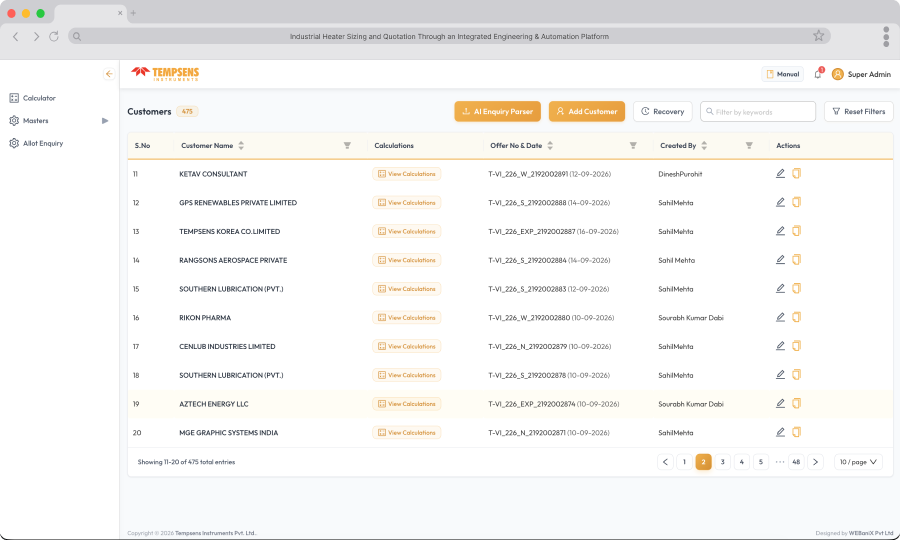
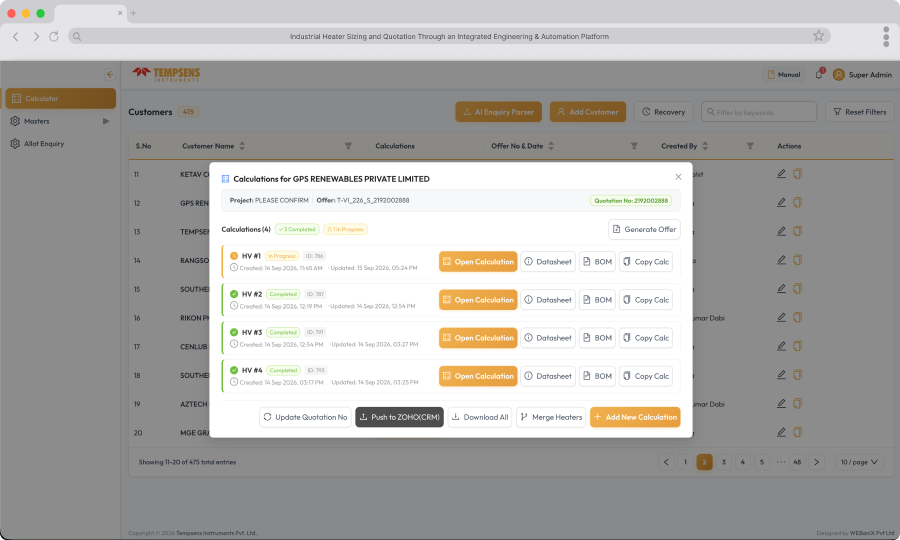
- A centralized customer and multi-calculation hub allows teams to manage multiple heating calculations, tenders, revisions, and multi-heater packages associated with customer projects. This provides a common workspace for engineering and commercial activities.
- Project documentation was organized through a standardized 14-folder structure covering specifications, final offers, costing, technical queries, subvendor quotations, purchase orders, thermal calculations, handover documents, VDRL, document submissions, progress reports, approved documents, and production drawings.
- Automated SharePoint synchronization connects the platform with cloud document storage. The system can provision customer project folders and organize generated offers, specifications, costing documents, supplier attachments, and other engineering documentation according to the defined project structure.
- The platform also includes centralized master data and configuration management. Administrators can maintain process fluids, sheath materials, flange weights, pipe schedules, units, raw material pricing, component pricing, configuration groups, and configuration parameters without requiring every operational change to become a separate development task.
- Role-based access, user administration, menu management, recovery controls, and audit logs provide additional governance across the platform. Audit logs record system activities with timestamps, user information, and event details, while role and privilege controls determine access to different platform areas.
Key Capabilities
- Centralized Heater Engineering: A unified platform for managing enquiries, engineering calculations, costing, quotations, ERP integration, documents, users, and configurations.
- Enquiry Work Queue: Manage incoming RFQs, plant assignments, engineer allocation, workflow statuses, and archived enquiries.
- AI Specification Extraction: Extract up to 80 engineering parameters from PDF and DOCX RFQ documents.
- Specification Verification: Review extracted values, confidence indicators, and technical parameters before creating engineering projects.
- SAP Customer Integration: Retrieve customer and enquiry information directly from SAP ERP through RFC integration.
- Multi-Calculation Management: Manage multiple heater calculations, tenders, revisions, and multi-heater packages under customer projects.
- Nine-Step Process Heater Sizing: Follow a structured engineering workflow for thermal and mechanical heater sizing.
- Thermodynamic Calculations: Calculate process requirements including heat duty and related thermal parameters.
- Element & Metallurgy Sizing: Configure element dimensions, heated lengths, sheath alloys, and related engineering parameters.
- Flange & Vessel Sizing: Configure flange ratings, vessel shells, pipe schedules, nozzles, insulation, and related mechanical requirements.
- Component & Industrial Heater Engineering: Manage dedicated sizing workflows for industrial and component heating solutions.
- Control Panel Engineering: Configure electrical requirements and generate associated engineering documentation and BOM information.
- Automated BOM Costing: Consolidate component and material pricing with additional costs and sales margins.
- BOM Validation: Validate engineering and commercial BOM information before quotation generation.
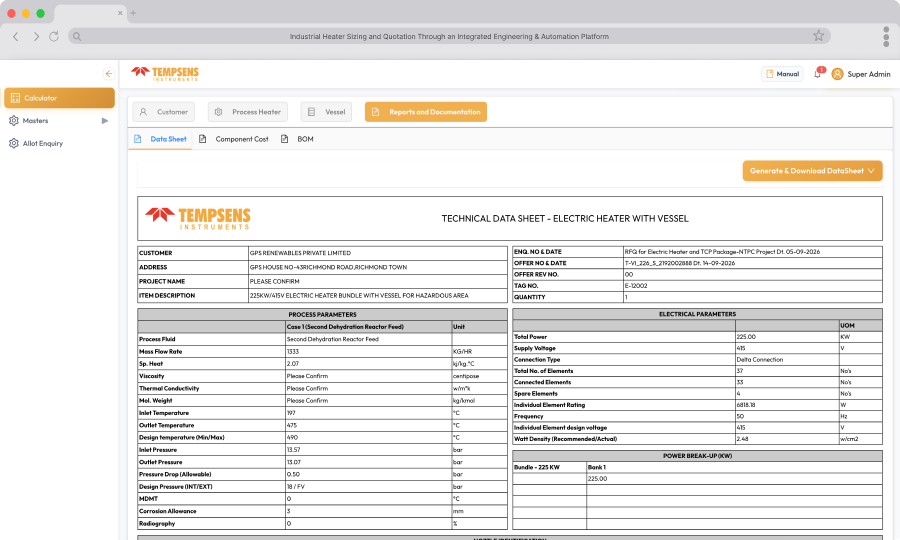
- Commercial Offer Generation: Generate branded Word-based commercial proposals from completed calculations.
- SAP Quotation Booking: Connect quotation creation with SAP ERP and obtain official quotation references.
- SharePoint Document Synchronization: Automatically organize and synchronize project documentation with the cloud.
- Standardized Project Documentation: Maintain a defined 14-folder project structure across pre-order and post-order activities.
- Centralized Master Data: Manage process fluids, materials, pricing, dimensions, configuration groups, and other engineering parameters.
- Role-Based Access: Control platform access according to user roles and privileges.
- Audit & Recovery Controls: Maintain activity records and recover soft-deleted customers or calculations when required.
Key Capabilities
- SAP-Integrated Order Processing: All orders—B2B and B2C—flowed into SAP in real time.
- Fast & Seamless Digital Experience: Optimized checkout and order management workflows
- Distributor-Friendly Architecture: Ensured channel harmony while expanding digital reach

Measurable Business Impact
The implementation of the Marathon Heater Sizing & Quotation Platform created a more connected approach to managing industrial heating projects, bringing enquiry intake, engineering, costing, quotation, ERP integration, and documentation into a common digital workflow.
Operational Efficiency
Previously disconnected activities such as unit scanning, crate assignment, inspection, testing, evaluation, and reporting are now organized within a connected digital workflow.This gives teams a consistent process to follow and reduces dependency on scattered operational records.
Service Visibility
The centralized records system and activity timeline provide teams with greater visibility into the status and history of individual units. Users can identify where a unit is within the evaluation process and review the activities associated with it, supporting better coordination and accountability.
Customer Experience
The structured evaluation workflow brings multiple inspection and testing activities together in one environment. Controlled editing of completed records also helps protect the accuracy and integrity of evaluation information.
UI Designs
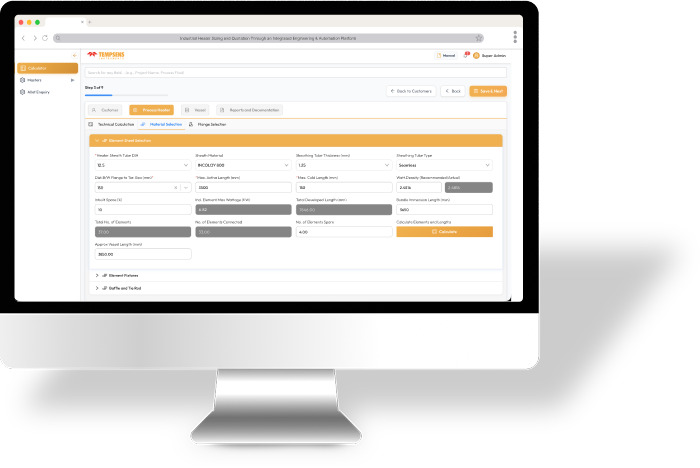
The platform interface was designed around the complete operational flow of industrial heater enquiry, engineering, costing, quotation, and documentation management.
The dashboard and navigation structure provide access to enquiry work queues, AI-assisted specification parsing, customer projects, engineering calculators, master data, document storage, and administration.
The enquiry interface provides plant-based filtering, assignment controls, workflow statuses, and actions for managing incoming RFQs. The AI Parser interface provides extracted technical parameters with confidence indicators and verification controls.
The customer and calculation interface provides a central workspace for customer projects and multiple heating calculations, while the engineering screens guide users through the structured sizing process.
Dedicated interfaces support component heaters, industrial heaters, and control panel engineering, while costing and BOM screens bring commercial and engineering information together.
The document interface provides a standardized project folder structure with document upload, preview, download, and management capabilities. SharePoint synchronization extends this document workflow into cloud storage.
Administrative interfaces provide control over users, roles, menus, audit logs, recovery records, master data, pricing, and configurable system parameters.
The overall interface focuses on making a technically complex engineering and commercial process easier to navigate while keeping important project information connected and accessible to authorized users.
Strategic Outcome
The implementation transformed the heater sizing and quotation process from a series of individual engineering and commercial activities into a connected digital workflow.
Teams gained a centralized environment for receiving and assigning RFQs, extracting technical specifications, managing customer projects, performing heater calculations, preparing BOMs, generating commercial offers, booking quotations in SAP ERP, and managing project documentation.
The platform also strengthened operational control through verification workflows, role-based permissions, audit trails, recovery capabilities, centralized master data, and standardized document management.
By connecting enquiry management, AI-assisted data extraction, engineering calculations, costing, quotation generation, ERP integration, and SharePoint document management within one platform, the solution established a more organized, traceable, and structured approach to industrial heater sizing and quotation operations.
The Biggest Win
The biggest win was creating one connected system for the complete heater sizing and quotation lifecycle.
Instead of handling RFQ information, technical parameters, engineering calculations, BOM costing, commercial offers, ERP quotation booking, and project documents through disconnected activities, teams can now manage these stages through a unified platform.
A customer RFQ can move from enquiry intake and specification extraction through verification, engineering sizing, costing, BOM validation, quotation generation, SAP booking, and project document synchronization.
The associated engineering information, commercial data, and project documentation remain connected throughout the process.
For the organization, this means a more structured engineering workflow, better control over technical information, stronger integration between engineering and commercial activities, and a centralized approach to managing industrial heating projects from RFQ to quotation.
Technology Stack & Delivery
Technology

React.js

Node.js with REST APIs
Integrated Workflow Automation System
Delivery Timeline

20 Weeks
Confidentiality

Masked